
Embracing AI in Health Technology Assessment: Insights from NICE’s Guidance

By , and
NICE outlines essential guidelines for responsibly integrating artificial intelligence into health technology assessment processes and evidence generation.
Embracing AI in Health Technology Assessment: Insights from NICE's Guidance

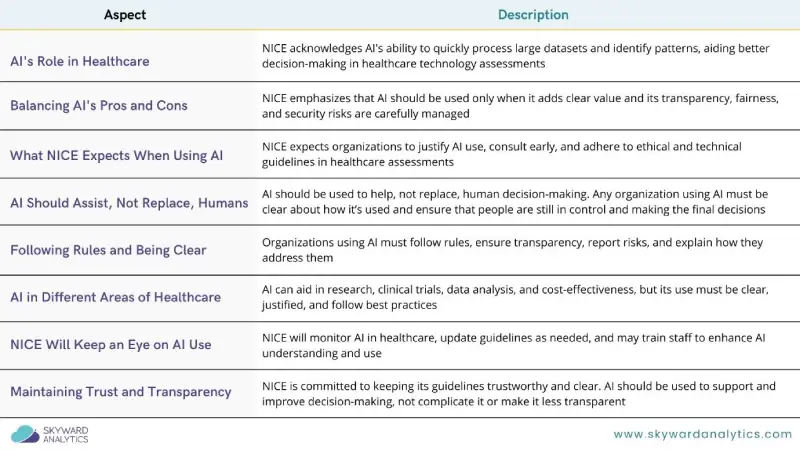
The integration of artificial intelligence (AI) into Health Technology Assessment (HTA) has become a focal point in the evolving landscape of evidence generation. The National Institute for Health and Care Excellence (NICE) has published a detailed position statement on the integration of AI in evidence generation for HTA. This guidance arrives at a pivotal time when AI’s potential to enhance evidence generation is being keenly explored across healthcare sectors. Below, we delve into the essential facets of NICE’s position and what it means for the future of HTA. Figure 1 summarizes the key points of NICE’s position on AI integration in HTA.
AI Integration in Health Technology Assessment
Figure 1. Key Points of NICE’s Position on AI Integration in Health Technology Assessment

1. Balancing Innovation with Risk

AI’s potential to transform evidence generation in HTA is undeniable. From automating literature reviews to enhancing the design of clinical trials, AI can significantly streamline processes. However, NICE emphasizes the importance of balancing these innovations against inherent risks, such as algorithmic bias, cybersecurity vulnerabilities, and transparency challenges. NICE suggests that AI should only be employed when it clearly adds value, ensuring that the benefits outweigh the potential downsides.

2. Human Oversight

AI should augment human decision-making, not replace it. NICE stresses the importance of keeping humans in the loop, ensuring that AI tools are used to enhance, rather than supplant, human expertise. This approach is crucial for maintaining ethical standards and ensuring the reliability of the evidence produced.

3. Ensuring Transparency and Accountability

NICE insists that organizations using AI in evidence generation must prioritize transparency. This means clearly justifying the use of AI, documenting methodologies, and ensuring that AI-driven results are understandable and accessible to all stakeholders. Transparency is vital to maintaining trust in the AI-generated evidence.

4. Early Engagement with NICE

Organizations considering the use of AI in their evidence generation processes are encouraged to engage with NICE early in the development process. This proactive approach can help ensure that AI methodologies are aligned with NICE’s expectations and regulatory standards from the outset, minimizing potential issues later on.

5. Building Trust through Compliance and Ethical Alignment

Any AI methods used must align with existing UK Government frameworks and ethical guidelines. This includes adherence to data protection laws and ensuring that AI applications are both scientifically and technically sound. Organizations are responsible for ensuring that all AI tools and methodologies meet these stringent standards.

6. Ongoing Monitoring and Adaptation

Given the rapidly evolving nature of AI technology, NICE plans to continually review and update its guidelines to reflect new developments and evidence. This commitment ensures that AI’s integration into HTA remains both innovative and responsible, ultimately supporting improved healthcare outcomes.

CONCLUDING REMARKS

NICE’s position on AI in HTA emphasizes the need for responsible, transparent, and ethical integration of AI technologies. While AI holds significant potential to transform HTA, NICE advocates for a cautious approach that safeguards the integrity of evidence generation and decision-making. By adhering to these guidelines, organizations can harness the power of AI to support and enhance evidence generation, ensuring that AI’s benefits are fully realized without compromising the quality or integrity of healthcare decisions.

References

  1. National Institute for Health and Care Excellence. (2024). Use of AI in evidence generation: NICE position statement. Retrieved from https://www.nice.org.uk/about/what-we-do/our-research-work/use-of-ai-in-evidence-generation–nice-position-statement

Senior Analyst-I, Skyward Analytics

Geetank brings a wealth of expertise in healthcare research and analysis. With a Master’s in Pharmacy from the prestigious National Institute of Pharmaceutical Education and Research (NIPER), Geetank specializes in scientific writing, literature reviews, and data extraction.

His proficiency extends to pharmacotherapeutics and biostatistics, allowing him to provide deep insights into complex healthcare topics. Geetank’s key focus areas include rheumatology, cardiovascular health, antimicrobial resistance, COVID-19, and medical devices.

Through his blog posts, Geetank aims to share valuable insights and contribute to the advancement of healthcare analytics. He leverages his academic background and professional experience to deliver informative and engaging content.

Follow Geetank Kamboj LinkedIn

Director & Senior Systematic Reviewer, Skyward Analytics

Rajpal brings 14 years of distinguished experience in Health Economics and Outcomes Research (HEOR) and healthcare. With a doctorate in Management Studies and a master’s degree in Pharmaceutical Sciences, he combines academic rigor with extensive practical expertise.

Rajpal brings 14 years of distinguished experience in Health Economics and Outcomes Research (HEOR) and healthcare. With a doctorate in Management Studies and a master’s degree in Pharmaceutical Sciences, he combines academic rigor with extensive practical expertise.

As a prolific researcher, Rajpal has contributed significantly to the field through multiple publications in peer-reviewed international journals. His comprehensive experience spans crucial HEOR deliverables, including systematic and targeted literature reviews, meta-analyses, and data landscape studies. He has also played a pivotal role in developing global value dossiers and creating impactful scientific presentations across various formats.

Rajpal’s therapeutic expertise is remarkably broad, encompassing Oncology, Ophthalmology, Respiratory, Cardiovascular, Neurology, Psychiatry, Immunology, Dermatology, Metabolic disorders, and Rare diseases. Through his blog contributions, he shares deep insights drawn from his extensive research experience, helping readers navigate the complex landscape of healthcare analytics and outcomes research.

Follow Dr. Rajpal Singh LinkedIn

Co-founder & CEO, Skyward Analytics

Hemant leads with a unique blend of industry and consultancy expertise gained from collaborating with global teams. As the driving force behind the company’s success, Hemant oversees all operations, from project execution and business development to financial and legal matters.

With extensive experience in healthcare economics, Hemant has established himself as an authority in developing pricing models, economic evaluations, and HTA submissions. His work has been recognized through multiple publications in national and international journals, reflecting his commitment to advancing the field of health economics and outcomes research.

Hemant brings deep therapeutic expertise across several critical areas, including Immunology and Dermatology, Oncology, Neuroscience, Cardiovascular, Ophthalmology, and Genetic disorders. Through his blog posts, he shares valuable insights drawn from his comprehensive understanding of the healthcare landscape and his practical experience in driving data-driven decisions in healthcare.

Follow Hemant Rathi LinkedIn
Our Services
HTA Submissions
Skyward Analytics supports pharmaceutical companies and midsize to large consultancies at various stages of a health technology assessment (HTA) submission.
Health Economic Modelling
We are experts in developing a variety of models widely used in HEOR. Our capabilities span all stages of model development for health economics and outcomes research.
Literature Reviews
We perform systematic literature reviews (SLR) and targeted literature reviews (TLR) to identify pertinent evidence related to the decision problem.
Meta Analysis
Meta analysis combines results from multiple studies to enhance understanding and inform decision-making in various fields.
Scientific and Value Communications
Focuses on clearly conveying complex scientific information and demonstrating the value of products to stakeholders for informed decision-making.
Real World Studies
Real World Studies (RWS) use real-world data to evaluate treatment effectiveness and safety in everyday healthcare settings.